
Bearing Fit Tolerances
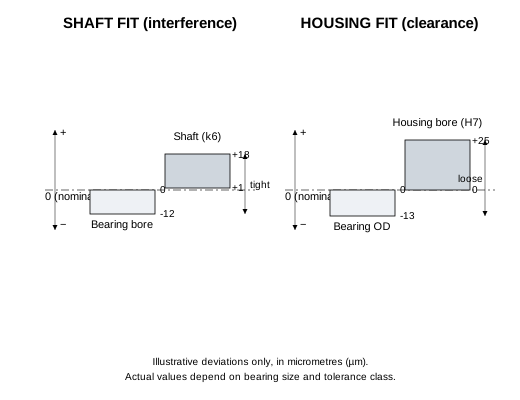
Bearing bores and outside diameters are held to their own special tolerance classes (to ISO 492), which are tighter than general ISO 286 tolerances and mostly biased to one side of the nominal size. Because of this, a "k6" shaft or "H7" housing paired with a bearing doesn't behave quite like the same letters would on two ordinary machined parts — the fit that results depends on the bearing's own tolerance as much as the shaft or housing. This page covers the basic selection principle, shaft fit tables for ball bearings, cylindrical, tapered and spherical roller bearings, and needle roller bearings, plus housing fit guidance. Recommendations follow the general standards published by major bearing manufacturers (NTN, SKF) for cast iron or steel housings and solid steel shafts.
THE BASIC SELECTION PRINCIPLE
The single most important question when choosing a bearing fit isn't the load's magnitude — it's which ring rotates relative to the direction of the load. Whichever ring rotates relative to the load needs an interference (tight) fit, so it can't creep round on its seat; the ring that stays stationary relative to the load can use a looser, transition, or clearance fit, which also makes it easier to fit and remove.
| FIT LOGIC BY LOAD CASE | ||
|---|---|---|
| Situation | Inner Ring (on shaft) | Outer Ring (in housing) |
| Shaft rotates, load direction is fixed (e.g. a typical motor or gearbox shaft) | Rotates relative to load → tight fit | Stationary relative to load → loose/transition fit |
| Shaft is stationary, housing rotates with the load (e.g. a wheel hub) | Stationary relative to load → loose/transition fit | Rotates relative to load → tight fit |
| Load direction itself rotates or is indeterminate (e.g. unbalance, vibration) | Both rings effectively see a rotating load → both may need a tighter fit than usual; internal clearance and thermal effects need extra care in this case | |
An inner ring given a clearance fit while it's the ring that rotates relative to the load is one of the most common causes of premature bearing failure — it creeps against the shaft, and that tiny repeated slip quickly wears both surfaces and lets in abrasive debris.
SHAFT FIT — BALL BEARINGS
The table below covers cylindrical bore ball bearings on a solid steel shaft, with the inner ring rotating (or the load direction indeterminate). "Light load" broadly means an equivalent bearing load Pr ≤ 0.06 Cr, and "normal to heavy load" means Pr > 0.06 Cr, where Cr is the bearing's basic dynamic load rating — check your bearing's rating against the actual applied load to see which column applies.
| SHAFT TOLERANCE — BALL BEARINGS, ROTATING INNER RING OR INDETERMINATE LOAD | |||
|---|---|---|---|
| Shaft Diameter (mm), over | Shaft Diameter (mm), up to and incl. | Light or Variable Load | Normal to Heavy Load |
| - | 18 | h5 | js5 |
| 18 | 100 | js6 | k5 |
| 100 | 140 | k6 | m5 |
| 140 | 200 | k6 | m6 |
| 200 | 280 | m6 | n6 |
SHAFT FIT — CYLINDRICAL, TAPERED AND SPHERICAL ROLLER BEARINGS
Roller bearings generally need a tighter shaft fit than a ball bearing of the same bore size under equivalent load, since roller contact concentrates load over a smaller area and the bearings themselves are typically used in heavier-duty applications. The two tables below cover cylindrical/tapered roller bearings and spherical roller bearings separately, again for a solid steel shaft with the inner ring rotating or the load direction indeterminate.
| SHAFT TOLERANCE — CYLINDRICAL AND TAPERED ROLLER BEARINGS | ||||
|---|---|---|---|---|
| Shaft Diameter (mm), over | Shaft Diameter (mm), up to and incl. | Light or Variable Load | Normal to Heavy Load | Very Heavy or Shock Load |
| - | 40 | js6 | k5 | - |
| 40 | 100 | k6 | m5 | - |
| 50 | 140 | k6 | m6 | n6 |
| 140 | 200 | m6 | n6 | p6 |
| 200 | 400 | - | p6 | r6 |
| SHAFT TOLERANCE — SPHERICAL ROLLER BEARINGS | |||
|---|---|---|---|
| Shaft Diameter (mm), over | Shaft Diameter (mm), up to and incl. | Normal to Heavy Load | Very Heavy or Shock Load |
| - | 40 | k5 | - |
| 40 | 65 | m5 | - |
| 50 | 100 | m6 | n6 |
| 100 | 140 | n6 | p6 |
| 140 | 280 | p6 | r6 |
| 280 | 500 | r6 | - |
For any of the bearing types above, where the inner ring is stationary relative to the load (e.g. an idler pulley on a fixed shaft), use g6 if the inner ring needs to be moved axially for adjustment, or h6 if it doesn't. For a tapered bore bearing fitted with an adapter or withdrawal sleeve, the shaft itself only needs an h9 tolerance (with an IT5 roundness/form requirement) since the sleeve, not the shaft fit, takes up the running fit — this is one of the main practical advantages of using a sleeve over a directly tapered shaft seat.
SHAFT FIT — NEEDLE ROLLER BEARINGS
Needle roller bearings are typically used where radial space is tight, so their recommended fits are organised a little differently — primarily by load type and speed rather than a single diameter/load grid.
| SHAFT TOLERANCE — NEEDLE ROLLER BEARINGS | ||
|---|---|---|
| Condition | Shaft Diameter | Fit |
| Rotating inner ring or indeterminate load — light load | ≤ 50mm | j5 |
| Rotating inner ring or indeterminate load — normal load | ≤ 50mm | k5 |
| Rotating inner ring or indeterminate load — normal load | 50–150mm | m5 |
| Rotating inner ring or indeterminate load — normal load | 150mm+ | m6 |
| Rotating inner ring or indeterminate load — heavy/shock load | ≤ 150mm | m6 |
| Rotating inner ring or indeterminate load — heavy/shock load | 150mm+ | n6 |
| Static inner ring load — medium/low speed, light load | all sizes | g6 |
| Static inner ring load — general application | all sizes | h6 |
| Static inner ring load — high rotation accuracy required | all sizes | h5 |
HOUSING FIT GUIDANCE
Housing fits follow the same "rotating ring gets the tight fit" logic, but are usually chosen a class or two looser than the equivalent shaft fit, since the outer ring is far more often the stationary member and split or removable housings need to come apart for maintenance.
| HOUSING TOLERANCE — BALL AND ROLLER BEARINGS | |
|---|---|
| Outer ring stationary, direction indeterminate load, light to normal | H7 |
| Outer ring stationary, needs axial float for thermal expansion (e.g. the "floating" bearing of a pair) | G7 |
| Outer ring stationary, direction indeterminate load, normal to heavy | JS7 |
| Outer ring rotating relative to the load, light or variable load | K7 |
| Outer ring rotating relative to the load, normal to heavy load | M7 |
| Outer ring rotating relative to the load, heavy load in a thin-walled housing | N7 |
| Outer ring rotating relative to the load, heavy shock load | P7 |
| HOUSING TOLERANCE — NEEDLE ROLLER BEARINGS | |
|---|---|
| Static inner ring load, outer ring rotating, normal to heavy load | J7 |
| Direction indeterminate load, normal load, split housing | H7 |
| Direction indeterminate load, light load | M7 |
| Direction indeterminate load, normal load | N7 |
| Direction indeterminate load, heavy and normal loads | P7 |
| Outer ring rotating load, light load | J7 |
| Outer ring rotating load, normal load | K7 |
| Outer ring rotating load, very heavy or shock load | M7 |
| High demands on running accuracy, light load | K6 |
For a typical electric motor or gearbox (rotating shaft, stationary housing, normal load), the H7/k6 or H7/m6 combination on housing/shaft is by far the most common pairing seen on general industrial equipment.
A few other factors can override the "standard" fit chosen from load and rotation alone: a difference in operating temperature between the inner and outer ring (heat conducted along a rotating shaft tends to expand the inner ring, loosening its fit, so a tighter class may be needed to compensate); a requirement for very high running accuracy, which is better solved with a higher-precision bearing and tighter-tolerance seats (IT5 instead of IT6) than by simply tightening the interference fit; and housings made from light alloy or plastic, which generally need a tighter fit than the equivalent cast iron or steel housing to achieve the same grip.
The maximum interference fitted to any bearing seat should generally stay below 1/1000 of the shaft or housing bore diameter — too tight a fit can induce enough stress into the rings to reduce bearing fatigue life, even though the fit is nominally "correct" for the load case.
Affiliate Partners
Related products that may help — using these links helps support the site.
Ball & roller bearing assortment kits
(Amazon.com)

Ball & roller bearing assortment kits
(Amazon.co.uk)