
Welding Symbols
Welding symbols let a drawing specify the type, size, location and finish of a weld without needing a separate note for every joint. This page covers how a full welding symbol is built up, the basic weld type symbols, the supplementary symbols used to add extra instructions to a weld symbol, and the weld face (contour) symbols shown on the near and far side of a joint, referencing both the international ISO 2553 standard and the US AWS A2.4 standard.
The elementary weld symbols themselves are identical, or very close to identical, between the two standards — the real differences between ISO 2553 and AWS A2.4 mostly show up in how the full welding symbol is built up around them (arrow/reference line conventions, tail contents, and some supplementary symbols). Where that's the case it's noted in the table.
ANATOMY OF A WELDING SYMBOL
A basic weld symbol on its own only shows the weld type. A full welding symbol wraps that basic symbol in a small amount of extra notation that tells the welder which side of the joint to weld, how big to make it, how long to run it, and any process reference — all without extra notes cluttering the drawing.
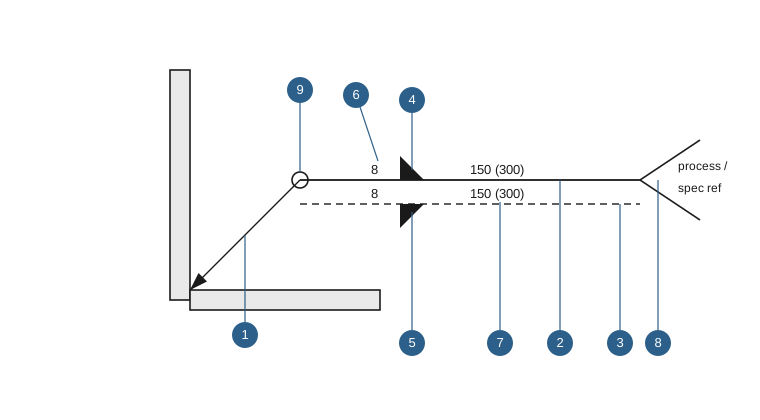
- Arrow line — points from the reference line to the joint being welded.
- Reference line — always drawn horizontally; every other part of the symbol is tied to it.
- Dashed line — used in ISO 2553 to distinguish the two sides of the joint; not used in AWS A2.4. It's omitted entirely if the weld is symmetrical on both sides.
- Weld symbol — other side — a symbol placed above the dashed line applies to the side of the joint opposite the one the arrow points to.
- Weld symbol — arrow side — a symbol placed below the solid reference line applies to the side of the joint the arrow points to.
- Size / dimension — a figure (e.g. leg length or throat thickness) placed to the left of the weld symbol, on the reference line.
- Length and pitch — for intermittent welds, the weld length and the spacing between welds, placed to the right of the symbol.
- Tail — an optional open fork at the end of the reference line, used to reference a welding process code, specification, or other note that doesn't have its own place on the symbol. It's omitted when there's nothing to reference.
Because the same-shaped symbol can sit above or below the line, the same basic weld type symbol can call up a weld on either side of the joint, or both, just by where it's drawn relative to the reference and dashed lines.
BASIC WELD SYMBOLS
| BASIC WELD SYMBOLS — ISO 2553 & AWS A2.4 | |||
|---|---|---|---|
| WELD TYPE | SYMBOL | STANDARDS | NOTES |
| Fillet | 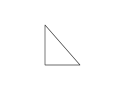 | ISO 2553 & AWS A2.4 | Same symbol in both standards |
| Square Groove |  | ISO 2553 & AWS A2.4 | Same symbol in both standards |
| V Groove | 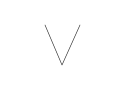 | ISO 2553 & AWS A2.4 | Same symbol in both standards |
| Bevel Groove | 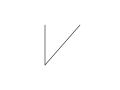 | ISO 2553 & AWS A2.4 | Same symbol in both standards |
| U Groove | 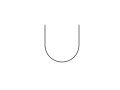 | ISO 2553 & AWS A2.4 | Same symbol in both standards |
| J Groove | 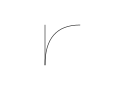 | ISO 2553 & AWS A2.4 | Same symbol in both standards |
| Flare-V Groove | 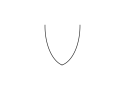 | ISO 2553 & AWS A2.4 | Same symbol in both standards |
| Flare-Bevel Groove | 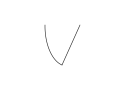 | ISO 2553 & AWS A2.4 | Same symbol in both standards |
| Plug / Slot |  | ISO 2553 & AWS A2.4 | ISO 2553 refers to this as a "slot" weld; AWS A2.4 covers plug and slot with the same symbol |
| Spot / Projection |  | ISO 2553 & AWS A2.4 | Same symbol in both standards |
| Seam | 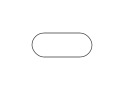 | ISO 2553 & AWS A2.4 | Same symbol in both standards |
| Backing |  | ISO 2553 & AWS A2.4 | Same symbol in both standards |
| Surfacing | 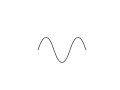 | ISO 2553 & AWS A2.4 | Same symbol in both standards |
| Edge |  | ISO 2553 & AWS A2.4 | Same symbol in both standards |
SUPPLEMENTARY SYMBOLS
These are added to a basic weld symbol, on or around the reference line, to give extra instructions about how or where the weld should be made.
| SUPPLEMENTARY WELD SYMBOLS — ISO 2553 & AWS A2.4 | |||
|---|---|---|---|
| SYMBOL MEANING | SYMBOL | STANDARDS | NOTES |
| Weld All Around | 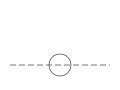 | ISO 2553 & AWS A2.4 | Circle placed at the junction of the arrow and reference line; same symbol in both standards |
| Field Weld | 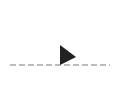 | ISO 2553 & AWS A2.4 | Filled flag at the junction of the arrow and reference line; same symbol in both standards |
| Contour — Flush | 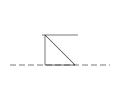 | ISO 2553 & AWS A2.4 | Straight line above the weld symbol; same symbol in both standards |
| Contour — Convex | 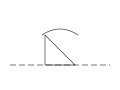 | ISO 2553 & AWS A2.4 | Outward curved line above the weld symbol; same symbol in both standards |
| Contour — Concave | 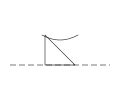 | ISO 2553 & AWS A2.4 | Inward curved line above the weld symbol; same symbol in both standards |
| Melt-Through | 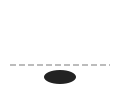 | ISO 2553 & AWS A2.4 | Filled lens shape on the side opposite the basic symbol; same symbol in both standards |
| Backing Bar |  | ISO 2553 & AWS A2.4 | A letter (R for removable, or similar) is often added inside the symbol in AWS A2.4 to show whether the backing is removed after welding |
| Consumable Insert | 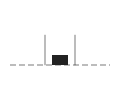 | ISO 2553 & AWS A2.4 | Shown as a filled square sitting in the root of a groove weld symbol; same symbol in both standards |
These are simplified reference renderings intended to help identify each symbol at a glance. For the exact proportions, dimensions and full rules on combining symbols, arrows, tails and reference lines, always refer to ISO 2553 or AWS A2.4 directly.
WELD FACE (CONTOUR) SYMBOLS — NEAR SIDE & FAR SIDE
The three contour symbols above — flat, convex and concave — describe the finished shape of the weld surface rather than the weld type itself, so they're always added alongside a basic weld symbol rather than used on their own.
- Flat face — the weld is finished flush with the surrounding material.
- Convex face — the weld surface bulges outward, above the surrounding material.
- Concave face — the weld surface is hollowed, sitting below the surrounding material.
Because a weld symbol can apply to the near side (arrow side) or far side (other side) of a joint, the contour symbol is drawn touching whichever reference line represents that side — the table below shows all six combinations.
| WELD FACE SYMBOLS — NEAR SIDE & FAR SIDE | |||
|---|---|---|---|
| SIDE | FLAT FACE | CONVEX FACE | CONCAVE FACE |
| Near side (arrow side) | 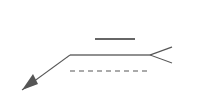 | 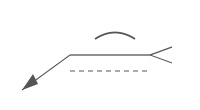 | 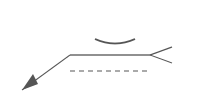 |
| Far side (other side) | 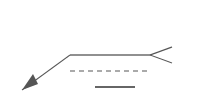 | 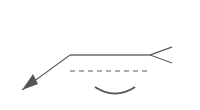 | 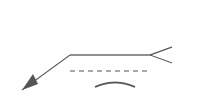 |
Affiliate Partners
Related products that may help — using these links helps support the site.
Welding tools & accessories
(Amazon.com)

Welding tools & accessories
(Amazon.co.uk)